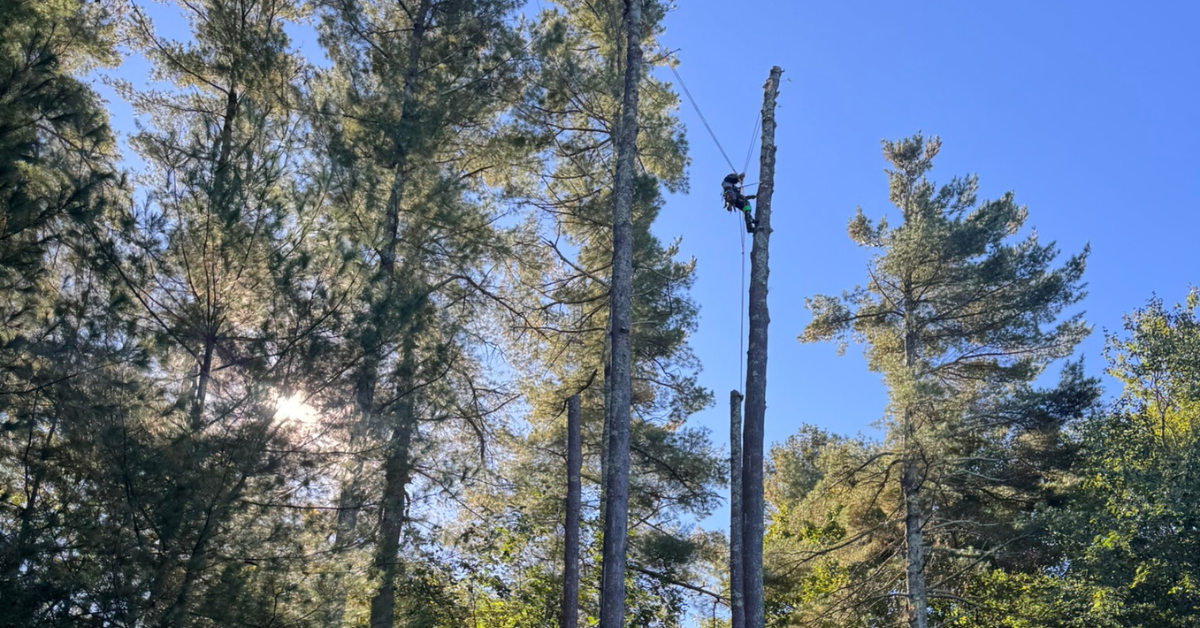
A mature tree with a split trunk union or heavy overextended limbs can fail without warning. In Greater Boston and the Boston area, snow load, coastal wind, and saturated spring soil place additional stress on weak branch attachments. When a tree provides significant shade or landscape value, structural support can often reduce failure risk without removal.
Dover Country Trees installs professional tree cabling and bracing systems throughout Greater Boston and Boston, MA. Our ISA-certified arborists evaluate structural defects and design ANSI A300 compliant support systems that stabilize vulnerable unions while preserving the tree whenever possible.
Call (508) 456-5777 to schedule your structural tree assessment.
Tree Cabling and Bracing in Greater Boston: Structural Support Solutions
Tree cabling and bracing are supplemental support systems designed to reinforce structurally weak branch unions. They are not cosmetic fixes. They are engineered solutions for otherwise healthy trees with identifiable failure points.
Our structural support service includes:
- On-site evaluation by an ISA-certified arborist
- Identification of codominant stems with included bark
- Static steel cable installation for high-risk splits over structures
- Dynamic cable systems for flexible load sharing without drilling
- Through-bolt brace rod installation in cracked or separating unions
- Corrective pruning to reduce canopy weight before hardware installation when necessary
- Written inspection and maintenance schedule recommendations
All systems are installed according to ANSI A300 Part 3 standards for supplemental support systems.
Signs You May Need Tree Cabling in the Boston Area
Structural weaknesses often develop over time. Many mature maples, oaks, and ornamental trees were never pruned for structure when young.
You should request an evaluation if you notice:
- A V-shaped trunk union where two stems compete for dominance
- Cracking or separation at a major branch attachment
- Heavy limbs extending horizontally over roofs or driveways
- Excessive movement during moderate wind events
- Previous storm damage that weakened a structural union
- Sudden canopy imbalance after heavy snow or ice accumulation
Not every structural defect requires hardware. Some trees can be stabilized with targeted pruning. A proper assessment determines the safest approach.
Call (508) 456-5777 to schedule an inspection before the next storm cycle.
Our Cabling and Bracing Process Across Greater Boston & Boston
Step 1. Structural Assessment
We perform a ground and aerial inspection to evaluate union strength, decay presence, canopy load distribution, and overall tree health. Soil stability and root anchorage are also considered, especially in clay-heavy sites common throughout the region.
Step 2. Risk Evaluation and Recommendation
We determine whether static cabling, dynamic cabling, bracing, pruning, or removal is appropriate. If a tree cannot be safely supported, we will recommend removal rather than installing hardware unnecessarily.
Step 3. Written Scope of Work
You receive a detailed written estimate outlining system type, hardware placement, and inspection schedule.
Step 4. Professional Installation
Static systems are drilled and bolted at specified heights above the weak union. Dynamic systems use high-strength synthetic materials that allow controlled movement without drilling. Brace rods are installed through compromised unions to prevent separation under load.
Step 5. Final Inspection and Maintenance Guidance
We verify hardware tension and provide recommendations for ongoing inspection. Annual inspection before winter storm season is typically advised in Greater Boston.
Call (508) 456-5777 to book your structural support consultation.
When Cabling Makes Sense Versus Removal
Cabling or bracing may be appropriate when:
- The tree is otherwise healthy with strong root anchorage
- The defect is limited to one or two structural unions
- The tree provides significant shade or landscape value
- Pruning combined with support reduces risk to an acceptable level
Removal may be necessary when:
- Internal decay significantly compromises trunk integrity
- Root failure or severe lean is present
- Multiple structural defects exist throughout the canopy
- The tree is in advanced decline from disease or infestation
We provide honest recommendations based on structural safety, not hardware sales.
Cost Factors for Tree Cabling and Bracing in Boston
Structural support pricing depends on measurable project conditions.
Primary cost drivers include:
- Number of cables and brace rods required
- Tree height and canopy spread
- Accessibility for aerial installation
- System type selected
- Corrective pruning scope prior to installation
- Ongoing inspection requirements
Each tree is evaluated individually. You receive a written estimate outlining the full scope before work begins.
Why Property Owners in Greater Boston Choose Dover Country Trees
- 25 years of combined field experience in Massachusetts tree care
- ISA-certified arborists trained in structural risk assessment
- ANSI A300 compliant installation practices
- TCIA membership and OSHA-compliant safety protocols
- Fully licensed, bonded, and insured
- Based at 5 Riga Rd, Dover, MA 02030 and serving the greater Boston region
We do not subcontract structural support work. Every installation is completed by our trained crew under arborist supervision.
Structural Tree Risks Unique to Greater Boston
The region experiences significant snow load, ice accumulation, and coastal wind events. Mature red maple, sugar maple, and red oak frequently develop codominant stems when early structural pruning was not performed.
Clay-heavy soils combined with seasonal freeze-thaw cycles can reduce root stability while canopy weight increases during late winter storms. Trees located near wetlands or slopes may experience amplified stress during heavy precipitation.
Proactive structural support before storm season reduces the likelihood of emergency removal after failure.
Primary Service Area: Greater Boston and Boston, MA
Dover Country Trees provides professional tree cabling and bracing services throughout the greater Boston area and across Norfolk, Middlesex, and Suffolk counties. Our coverage includes Newton, Brookline, Needham, Wellesley, Weston, Natick, Concord, Cambridge, and surrounding communities.
Contact (508) 456-5777 to confirm availability and schedule a structural assessment for your property.
Frequently Asked Questions About Tree Support Systems
Will cabling damage my tree?
Properly installed static systems involve small drilled hardware that trees compartmentalize over time. Dynamic systems use external support materials and require no drilling.
How long do support systems last?
Static steel systems can remain effective for decades with routine inspection. Dynamic systems typically require inspection every few years and replacement when material wear is observed.
How often should cabling be inspected?
Annual inspection is recommended, particularly before winter storm season in Greater Boston.
Is cabling more cost-effective than removal?
When a tree is structurally sound aside from one or two weak unions, cabling is often less disruptive and more economical than removing a mature tree.
Can you install support on trees over homes or garages?
Yes. Many installations are performed on trees extending over structures. Access planning and safety controls are included in every assessment.
Schedule Your Free Structural Assessment in Greater Boston & Boston
If you have a tree with visible splitting, codominant stems, or heavy limbs over structures, schedule a professional evaluation before the next storm season.
Call (508) 456-5777 to book your free on-site assessment. A certified arborist will inspect your tree, explain the safest option, and provide a written plan so you can move forward with confidence.