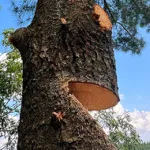
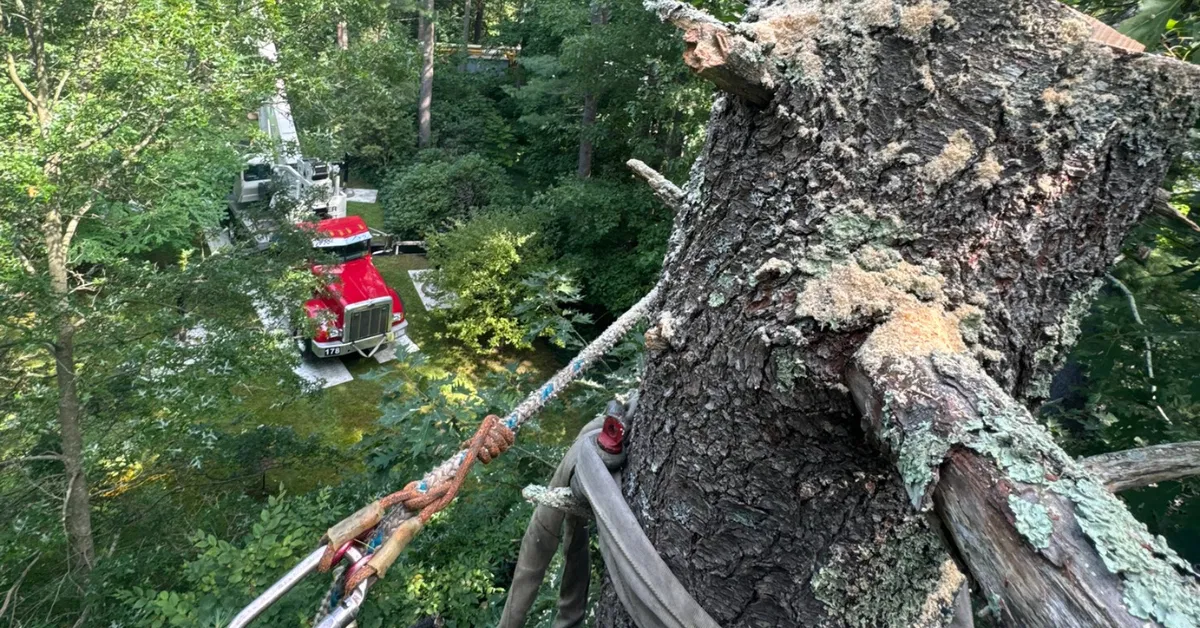
Dover Country Trees provides professional tree risk assessments performed by ISA-certified arborists throughout Greater Boston and Boston, MA. We evaluate structural integrity, decay, root stability, and site exposure, then deliver a written report with risk ratings and specific recommendations.
Call (508) 456-5777 to schedule your tree risk assessment.
What Is Included in a Professional Tree Risk Assessment?
A tree risk assessment is a structured evaluation based on ISA methodology. It determines the likelihood of failure, the potential target if failure occurs, and the consequences of that impact.
Our assessment process includes:
- Identification of structural defects such as codominant stems, included bark, cracks, cavities, and deadwood
- Evaluation of trunk and root flare condition, including visible decay and fungal indicators
- Canopy health analysis, including dieback patterns and load distribution
- Soil and drainage review, especially in clay-heavy sites common throughout the region
- Target assessment identifying structures, walkways, vehicles, or play areas within the potential impact zone
- Assignment of a standardized risk rating category
- Written mitigation recommendations such as pruning, cabling, monitoring, or removal
You receive a documented report that supports decision-making, insurance communication, and liability management.
When Property Owners in the Boston Area Should Schedule a Tree Inspection
Consider a tree risk assessment if you notice:
- A visible trunk crack or expanding split at a branch union
- A sudden lean following heavy rain or freeze-thaw cycles
- Large dead limbs over structures or driveways
- Repeated limb drop after moderate wind events
- Fungal growth at the base of the trunk
- Construction activity near the root zone of mature trees
- Real estate transactions requiring documented tree condition
- Insurance requests for formal inspection documentation
If you are unsure whether an assessment is necessary, a brief phone consultation can help determine the next step.
Call (508) 456-5777 to discuss your concern.
Our Tree Risk Evaluation Methods
ISA standards define three levels of assessment. We recommend the appropriate level based on site conditions and concern severity.
Level 1. Limited Visual Screening
A broad visual scan used for large properties, associations, or campuses with multiple trees. This level identifies which trees require closer inspection.
Level 2. Basic Tree Risk Assessment
A detailed 360-degree ground-level inspection of an individual tree. The arborist evaluates trunk integrity, branch structure, root flare, and site exposure. A written report with risk rating and recommendations is provided.
Level 3. Advanced Assessment
When additional investigation is required, advanced diagnostic methods may be used. These can include resistance drilling to measure internal decay, aerial inspection of upper canopy defects, or root collar excavation to assess below-grade stability.
Advanced assessments are typically reserved for high-value trees or situations where structural failure would result in significant damage.
Our Tree Risk Assessment Process in Greater Boston
Step 1. Initial Consultation
You describe the concern and the property context. We determine the appropriate assessment level.
Step 2. On-Site Inspection
An ISA-certified arborist conducts the visual or advanced evaluation. Structural load, species characteristics, soil conditions, and exposure are considered together.
Step 3. Risk Rating and Documentation
We assign a standardized risk category and prepare a written report detailing findings, photographs, and mitigation options.
Step 4. Recommendation Review
We review the report with you and explain practical next steps. If mitigation work is advised, separate written estimates are provided.
Call (508) 456-5777 to schedule your inspection.
Cost Factors for Tree Risk Assessments in Greater Boston & Boston
Assessment pricing depends on measurable project factors rather than flat rates.
Primary cost drivers include:
- Assessment level required
- Number of trees evaluated
- Property size and access conditions
- Report complexity for insurance or legal documentation
- Advanced diagnostic tools when necessary
Each assessment is quoted individually before scheduling so scope and expectations are clear.
Why Property Owners Choose Dover Country Trees
- ISA-certified arborists performing every assessment
- 25 years of combined field experience in Massachusetts tree care
- TCIA membership and OSHA-compliant safety practices
- Written documentation aligned with ISA methodology
- Fully licensed, bonded, and insured
- Based at 5 Riga Rd, Dover, MA 02030 and serving the greater Boston region
We do not use assessments to promote unnecessary removals. If a tree is stable, we document that. If monitoring is appropriate, we establish a re-inspection schedule. Recommendations are based on structural evidence and site risk, not sales goals.
Tree Risk Factors Unique to Greater Boston
Mature hardwood populations across Greater Boston include red oak, sugar maple, white oak, and white pine. Many were never structurally pruned when young, resulting in codominant stems and weak unions.
Seasonal nor’easters and heavy ice events place additional load on branch attachments. Clay-heavy soils common in parts of Norfolk and Middlesex counties retain moisture during spring thaw, reducing root anchorage at the same time canopy weight increases.
Construction activity, driveway expansions, and grading changes can compromise root systems years before symptoms become visible. A professional risk assessment identifies these issues before failure occurs.
Service Area Coverage
Primary Service Area: Greater Boston and Boston, MA
We provide certified tree risk assessments throughout the greater Boston area and across Norfolk, Middlesex, and Suffolk counties. Coverage includes Newton, Brookline, Needham, Wellesley, Weston, Natick, Concord, Cambridge, and surrounding communities.
Contact (508) 456-5777 to confirm service availability.
Frequently Asked Questions About Tree Risk Assessments
How long does a tree risk assessment take?
A standard Level 2 assessment typically requires 30 to 60 minutes per tree depending on size and complexity. Larger properties or advanced assessments may require additional time.
Can the report be used for insurance purposes?
Yes. Our written reports follow ISA methodology and include documented risk ratings and arborist credentials suitable for insurance communication.
How often should mature trees be inspected?
Inspection frequency depends on tree condition and exposure. High-value trees near structures are often evaluated every one to three years, or after major storm events.
Do I need a formal assessment before removing a tree?
If a tree is clearly dead or severely compromised, removal can often be quoted without a formal report. A documented assessment is most valuable when risk level is uncertain or documentation is required.
What happens if a tree is rated high risk?
The report will outline specific mitigation options such as pruning, structural support, monitoring, or removal. We provide separate written estimates for any recommended work.
Schedule Your Tree Risk Assessment in Greater Boston & Boston
If you have concerns about a leaning tree, visible cracking, or storm damage, schedule a professional evaluation before the next weather event.
Call (508) 456-5777 to book your on-site assessment. A certified arborist will inspect your trees, explain the findings clearly, and provide a written plan so you can make an informed decision.